80% of job seekers now use artificial intelligence tools to write or improve their resumes. This figure, unthinkable just three years ago, reveals a deep transformation in how people search for jobs. But behind this massive adoption lies a paradox: 62% of hiring managers reject AI-generated resumes that lack personalization.
AI is a powerful tool — when used correctly. In this article, we explore how artificial intelligence is changing the game for candidates, the pitfalls to avoid, and how to choose an AI resume builder that actually works for you. If you want a tool that goes beyond form-filling, check out our plans.
The Rise of AI in Resume Building
The resume builder market was valued at $2.18 billion in 2024. Projections place it at $5 billion by 2035, driven by the explosion of generative AI tools. This is not a niche phenomenon — it is a structural transformation of the job market.
The numbers confirm this trend. 47% of college seniors already use AI to write their resumes. Among working professionals, 25% of Gen Z actively use these tools, and adoption is rapidly spreading across all age groups. In the US alone, 28% of Americans were actively job searching in 2024 — the highest rate since 2014 — fueling demand for efficient application tools.
This growth is driven by a concrete need: candidates send dozens of applications on average before landing an interview. Manually tailoring each resume to each job posting is time-consuming and discouraging. AI promises to automate this adaptation — but not all tools deliver on that promise in the same way.
What AI Does Well (and What It Gets Wrong)
The strengths of AI for resumes
AI brings real, measurable advantages to resume creation:
- Significant time savings: users report a 65% reduction in creation time compared to manual writing. For a candidate applying to 20 positions, that is the difference between weeks of work and a few hours.
- Automatic ATS optimization: AI can analyze a job posting and identify the keywords to include in order to maximize compatibility scores with Applicant Tracking Systems. To understand how ATS works in detail, read our article Why Your Resume Is Rejected by ATS.
- Hidden skills extraction: a good AI tool does more than rephrase — it identifies skills you underestimate or forget to mention, based on your experiences and achievements.
The limitations of generic AI tools
The weaknesses are equally real:
- Generic content: many tools produce "word salad" — text stuffed with keywords but lacking substance or context. The result? A resume that might pass ATS filters but convinces no recruiter.
- Loss of personal voice: 82% of hiring managers say they can detect an AI-written resume. When every candidate uses the same tool with the same prompts, resumes start looking identical. The recruiter no longer sees the person behind the document.
- Fabricated data: some tools hallucinate skills or certifications the candidate does not possess. A resume that lies is worse than an imperfect one — it destroys credibility at the first interview question.
The conclusion is clear: AI is an assistant, not a replacement. Personalized resumes generate 6 interviews per 100 applications, compared to fewer than 3 for generic ones. The tool you choose makes all the difference.
The 3 Generations of AI Resume Tools
To understand where the market stands, you need to distinguish three fundamentally different approaches.
Generation 1: static templates
Tools like Canva or Google Docs offer pre-formatted resume templates. You fill in the fields, choose colors, and export. It is simple, often free, and perfectly suited if you know exactly what to write. The problem: these tools do not help you think about your content. They format, period. Moreover, visually sophisticated templates (columns, charts, icons) are often incompatible with ATS systems.
Generation 2: forms + generative AI
This is the approach of most current tools — Zety, Resume.io, MyPerfectResume. You fill out a structured form (title, company, dates), and AI generates bullet points from your answers. It is faster than writing from scratch, but the result remains generic. The AI rephrases what you give it without asking additional questions, without looking for what is missing, without adapting content to a specific job posting.
Another recurring problem with this generation: deceptive pricing. Many platforms market themselves as "free," let users spend hours building their resume, then lock the download behind a hidden subscription. Trial offers of $2.95 silently convert to $20-40/month subscriptions buried in fine print.
Generation 3: conversational AI coaching
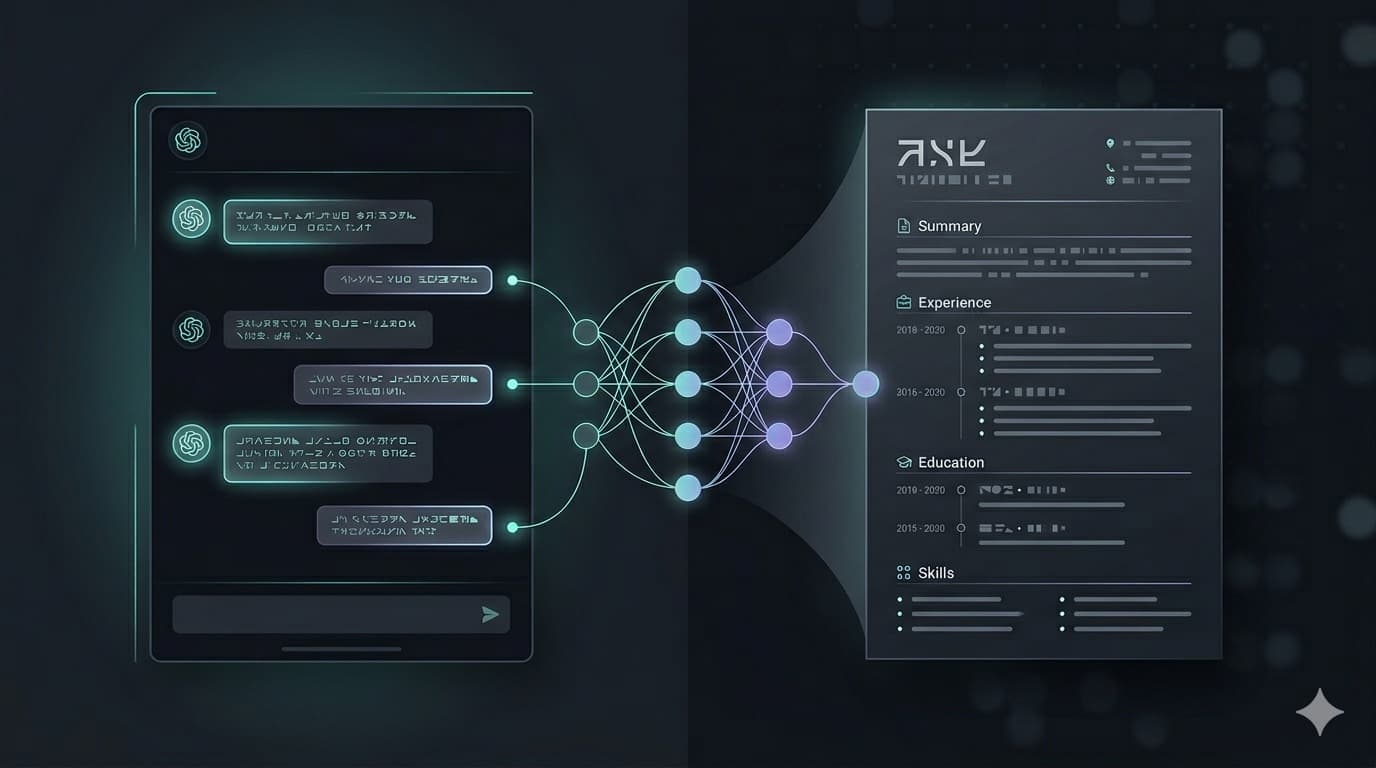
This is the approach adopted by VitamCV. Instead of filling out a form, you chat with an AI coach that asks you targeted questions. This conversation surfaces skills you would not think to mention, recontextualizes your experiences for each specific job posting, and identifies gaps between your profile and the target position.
The fundamental difference: a form captures what you already know. A coach reveals what you underestimate.
How to Choose an AI Resume Builder
With so many tools available, here are the criteria that separate the good from the bad.
What to look for
- Personalization vs generic: does the tool actually adapt content to each job posting, or does it produce the same result regardless of the position? Ask yourself: could I send this resume as-is to any company? If yes, it is not personalized enough.
- Transparent ATS scoring: artificially inflated ATS scores are a marketing trap. A good tool explains how the score is calculated — ideally through a programmatic analysis of the overlap between your resume and the job posting, not a cosmetic estimate.
- Honest pricing: the first sign of a trustworthy tool is pricing transparency. No free trial that converts into a subscription, no essential features hidden behind a paywall after hours of work.
Red flags
- A "free" tool that locks the download
- ATS scores of 95% with no explanation of the method
- No DOCX format available (the most ATS-compatible format)
- Massively negative Trustpilot reviews mentioning deceptive billing practices
- No ability to freely edit your resume sections
The VitamCV Approach: Coaching Over Form-Filling
VitamCV takes the opposite approach to traditional tools. Instead of asking you to fill in fields, our AI coach asks intelligent questions to surface the real value of your career.
Underestimated skills. Imposter syndrome affects the majority of candidates: you do not realize that your everyday skills are exactly what the recruiter is looking for. The AI coach identifies these hidden skills and helps you articulate them compellingly.
Tailored to each job. Every resume generated by VitamCV is adapted to a specific job posting. The AI analyzes the listing, extracts required keywords and skills, and identifies gaps between your profile and the position. You never submit a generic resume. For a detailed walkthrough of the tailoring method, read our guide How to Tailor Your Resume to a Job Posting.
Programmatic ATS scoring. VitamCV's ATS score is calculated through a mathematical analysis of the overlap between your resume and the job posting — not by an opaque algorithm that inflates numbers to make you feel good. Every point in the score is explained and actionable.
Anti-imposter coaching. The AI coach does not just generate text — it helps you recognize and value your achievements. This is the difference between a tool that formats and an assistant that reveals your potential.
Transparent pricing. The first resume is free, no credit card required. Credits are purchased individually, with no hidden subscription or automatic renewal. For details, see our pricing page.
FAQ
Can hiring managers detect AI-written resumes?
Yes, in most cases. 82% of hiring managers say they can identify an AI-written resume. The telltale signs are generic vocabulary, identical phrasing across candidates, and a lack of details specific to the company or role. The solution is not to avoid AI, but to use it as a thinking assistant rather than an automatic generator. A resume coached by AI — where the candidate brings their own voice and real experiences — is indistinguishable from a manually written one.
Can an AI resume builder replace a human career coach?
An AI tool will not replace in-depth human guidance for complex career transitions or comprehensive skills assessments. However, for day-to-day resume optimization — adapting to job postings, identifying ATS keywords, highlighting skills — AI delivers comparable results at a fraction of the cost and time. VitamCV combines both approaches: the depth of conversational coaching with the efficiency of automation.
Do AI-generated resumes pass ATS filters?
It depends entirely on the tool. Tools that simply generate text without analyzing the target job posting produce resumes that are not ATS-optimized. Tools that specifically analyze the posting and adapt keywords accordingly — like VitamCV — produce resumes with significantly higher ATS compatibility rates. The critical element is adaptation to each job, not generic generation.
Does VitamCV make up skills?
No. VitamCV never fabricates skills, certifications, or experiences. The AI coach works exclusively from what you share in the conversation. Its role is to reveal and reframe skills you actually possess but do not know how to showcase — not to invent what does not exist. Every suggestion is transparent and editable. See our FAQ for more details on our transparency commitment.
Take Action
AI is transforming job search — that is a fact. The question is no longer whether you should use AI for your resume, but how to use it well. Generic tools produce generic resumes. Conversational AI coaching produces a resume that truly reflects who you are and what you bring.
VitamCV combines the power of AI with the depth of personalized coaching. The first resume is free, no credit card required, no commitment.